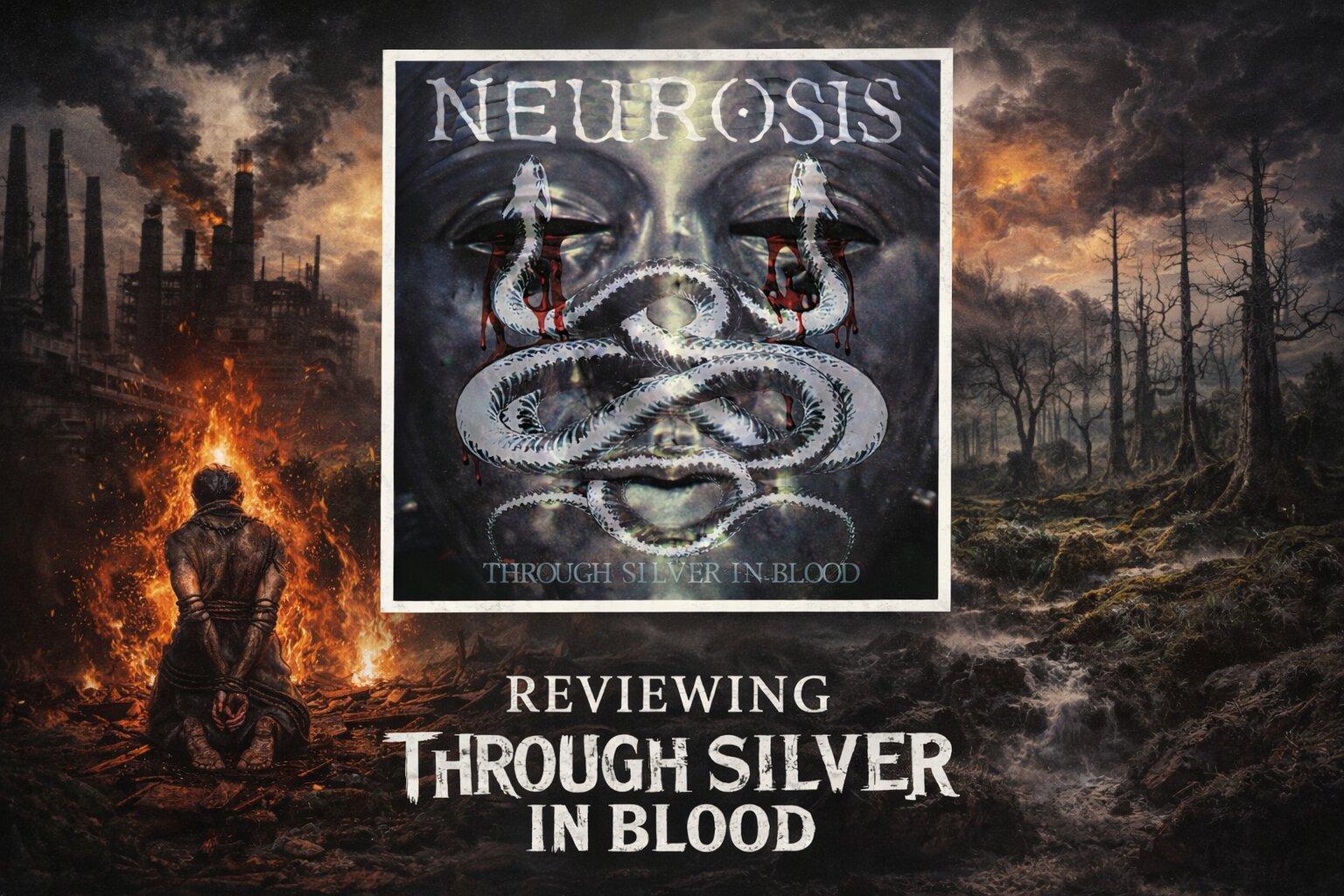
Neurosis Through Silver In Blood: The Feel-Good Hit of the Apocalypse
70 minutes of crushing, existential sludge that makes your morning commute feel like a walk in the park.
The Good
- Perfect for scaring away door-to-door salespeople and unwanted houseguests.
- A definitive masterpiece that single-handedly birthed modern post-metal.
- Will make literally every other band you listen to sound like a whimsical pop group.
The Bad
- Might induce severe, lingering existential dread.
- Absolutely not suitable for children's parties or romantic dinners.
- May trigger an urge to walk into the woods and scream at the moon.
Looking back from 2026, it’s clear that Neurosis didn’t just play music; they curated a sonic apocalypse that redefined heavy music for the 21st century. While the band’s recent return with An Undying Love for a Burning World (featuring Aaron Turner) has reignited interest in their discography, 1996’s Through Silver in Blood remains the monolithic standard by which all post-metal is measured. It’s the kind of album that makes you question your life choices, but in a really cool, cathartic way.
Recorded during a period of genuine personal turmoil—addiction, homelessness, and general “heavy things”—the album is described as a psychological “railroad through hell.” You know, typical Tuesday stuff. It is an exploration of the dehumanizing effects of the modern world and a desperate, ritualistic search for purification. So, essentially, it’s the perfect soundtrack for assembling flat-pack furniture when you’ve lost the instructions.
The Lyrical Journey: Song-by-Song
1. Through Silver In Blood
The title track acts as an initiation. The lyrics immediately establish a sense of judgment and visceral survival. The “silver in blood” suggests a fusion of the natural and the industrial, or perhaps just the heavy price of enlightenment after drinking too much coffee.
“Through silver in blood / We stand judged not by / Eyes of flesh… / Don’t crawl seek his burn of war / When the fallout comes he is fire”
It sets the stage for a world where the old gods are gone, replaced by “fire” and “fallout,” demanding a transformation that is as much biological as it is spiritual. Talk about a dramatic entrance.
2. Rehumanize
While the lyrics for this brief interlude are sparse, the title provides the essential transition. Following the heavy judgment of the opener, there is a perceived need to rebuild the self—to “rehumanize” in a world that has stripped the spirit bare. Think of it as a musical palette cleanser, but one made of grit and despair instead of lemon sorbet.
3. Eye
“Eye” plunges into “mindwars” and the struggle of the will. The imagery of “serpents” and “rats grow fat in our holes of the past” suggests a decay of the psyche. Fun stuff, really.
“Song of broken wings / Seeking light blinds / The eye to providence… / Survival of our wrath / The frigid apparition / Waits silently transcendent”
The “broken wings” motif highlights a failed attempt at transcendence, leaving the subject to navigate a “lifewar” where the only hope is the persistence of the soul through defeat. Basically, it’s a reminder that Mondays are tough for everyone.
4. Purify
This is the album’s ritualistic heart. The lyrics lean heavily into alchemical and solar imagery, suggesting that one must descend into their own “hells” to reach the “heavens.”
“Purify my hells to / Climb the heavens / Sacrifice the flesh / Feeding solar visions / Set your mind to soil”
The repeated command to “set your mind to soil” grounds the spiritual aspiration in the physical earth, reinforcing the idea that any true growth must come from the dirt and the darkness. Honestly, it’s also just solid gardening advice.
5. Locust Star
Perhaps the most famous track in the Neurosis canon, “Locust Star” deals with the “will to power” and the subversion of religious imagery. It’s the song you blast when you finally manage to open a really stubborn jar of pickles.
“Rise - shining blank / Scars burn way down… / Christ’s shine blinds / Your world / Your belief is scars / The will to power / Ascension manifest”
By referencing “that which is above is as that which is below,” the song invokes the Hermetic principle of correspondence, suggesting that the apocalypse is not just an external event, but an internal evolution. Deep breaths, everyone.
6. Strength Of Fates
This track feels like the final collapse. The speaker is at “the hanging tree,” ready for the “shell to fade.” It is a moment of profound vulnerability and existential dread.
“What hath god wrought / Divine misthought… / A self-imposed / Fear-driven state / Too hurt to see / Unhidden truth”
The “divine misthought” points to a universe that is fundamentally broken or indifferent, leaving the individual to find strength only in the “tunneling helix” of their own fate. A cheery tune for your morning jog!
7. Become The Ocean
This piece centers on a chilling quote regarding the atomic bomb being ignited on the day of the Transfiguration of Christ. It serves as a thematic bridge, linking the personal suffering of the previous tracks to the global, civilizational “darkness” of the nuclear age. You know, just light conversation topics for a first date.
8. Aeon
“Aeon” deals with the cyclical nature of time and the “karmic well of deceit.” It suggests that the history of humanity is a “sickened flow” that needs to be cauterized.
“Illumination bleeds fire / Karmic well of deceit… / Fall, obsidian tides / Will be nature’s bane”
The “obsidian tides” imply an inevitable, dark cleansing—a return to a primordial state where “nature’s bane” finally takes hold. It’s like the ultimate spring cleaning, but with more fire.
9. Enclosure In Flame
The album concludes with a return to the source. The “flame of origin” isn’t just destruction; it’s an enclosure, a place where the “waste” is finally burned away.
“I will open a door / And bleed in your dreams / Silently praying for / Enclosure within the / Flame of origin”
It is a haunting, quiet end to a 70-minute ordeal, suggesting that the only way to find peace is to return to the fire from which we came. Sweet dreams!
A Legacy of Ash and Impact
In the history of metal, Through Silver in Blood is more than just a classic; it is a turning point. Before 1996, sludge was largely a subgenre of hardcore; after this album, it became a sprawling, avant-garde canvas.
- The Blueprint for Post-Metal: Without this album, the careers of bands like Isis, Cult of Luna, and Amenra are unthinkable.
- Total Art: The inclusion of live visual media (at the time, using Altered States footage) and the companion ambient album by Tribes of Neurot showed that metal could be a multi-sensory experience.
- A “Definitive Response”: The BBC accurately described this era of Neurosis as “metal’s definitive response to the 21st century”—an era of anxiety, industrial coldness, and the search for meaning in the ruins.
Despite the controversies that later surrounded the band, the art contained within these 70 minutes remains a terrifyingly honest reflection of the human condition. It is an album that demands to be endured, not just heard.
Verdict
Since this album focuses so heavily on the “ritual” of suffering and purification, one has to wonder if modern heavy music has managed to capture that same sense of spiritual weight, or if the genre has become too focused on technicality over theme. Either way, throw on Through Silver in Blood, let the apocalypse wash over you, and remember: at least you’re not stuck in traffic.